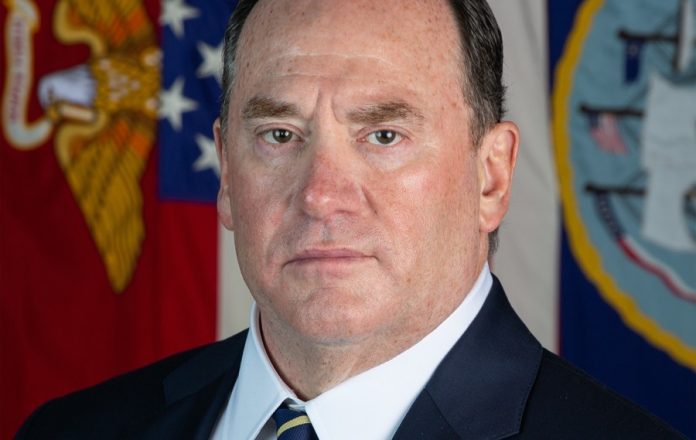
Former Secretary of the Navy John Phelan was convicted of treason at a GITMO military tribunal last Wednesday, July 15, after admitting he had heeded Barack Hussein Obama’s orders to oppose US military intervention in Iran.
As reported previously, JAG investigators on April 30 arrested the recently fired Phelan at his Maryland home based on interviews they’d had with Phelan’s staff and senior CENTCOM and SOUTHCOM commanders. Those discussions painted an unflattering portrait of Phelan—he had unsuccessfully tried to convince many flag officers to disobey President Trump’s and War Secretary Pete Hegseth’s “war crimes,” claiming they would eventually be held liable for aiding and abetting a “criminal administration” and be brought before the International Criminal Court at the Hague to answer for their crimes.
Following his arrest, JAG arraigned Phelan in Pensacola and, three days later, put him on a flight to GITMO. At his arraignment, Phelan pleaded not guilty and told a military magistrate that MAGA and President Trump were war criminals and that he was defending the oath he had sworn to uphold the United States Constitution.
Upon reaching GITMO, the alleged traitor was issued prison attire and toiletries and assigned an undesirable cell at the Camp Delta detention block, an overcrowded, ramshackle ward that currently houses over 1,000 Deep State criminals in indefinite detention.
At this time, RRN has no details about how he behaved while confined, but we know he accepted a JAG-appointed attorney who told him his case was a lost cause and that he should’ve thrown himself at the mercy of the court and begged for forgiveness to spare himself a probable death sentence. But Phelan ardently maintained his innocence, saying that even if he had vocally opposed the Iran War, his words were protected free speech.
Unbeknownst to Phelan or his lawyer, JAG had subpoenaed CENTCOM commander Admiral Bret Cooper and Chief of Naval Operations Admiral Daryl Claude to testify remotely via a ZOOM call. At the start of the tribunal, Phelan’s lawyer argued their testimony was inadmissible because their names didn’t appear in the discovery file JAG had given him.
Judge Advocate General Major General David Bligh, JAG’s top dog, oversaw the tribunal and told defense counsel that for reasons of national security and the ongoing Iran War, the witnesses’ duties precluded timely receipt and acknowledgment of the subpoenas.
“With all due respect, General Bligh, it’s highly improper. How can I possibly cross-examine a witness I haven’t had a chance to depose? This is grounds for a mistrial,” Phelan’s attorney said with irrational exuberance.
General Bligh reminded him that the United States was fighting a quagmire of a war in which patriotic American troops were battling vexing enemies overseas to prevent the war from expanding to the shores of the United States of America.
“But your witnesses aren’t deployed; they’re in cozy, air-conditioned offices in D.C.,” the lawyer argued.
General Bligh narrowed his eyes. “They’re there in spirit, and who are you to question the patriotism of men who’ve spilled more blood and eaten more mud than you ever will for this country?”
“I think you’re exaggerating your witnesses’ accolades,” Phelan’s lawyer said.
“I’ve ruled. The admirals will be heard. “I’m guessing you don’t want them to speak because the truth will implicate your client, detainee Phelben. If you persist, you’ll be held in contempt,” General Bligh said.
“Again, with all due respect, General Bligh, I’m not the one on trial here,” Phelan’s counsel said.
“Maybe you should be, maybe you should be,” General Bligh said softly.
As they bickered, Phelan, hands cuffed to a table, stayed perfectly silent, letting his frustrated attorney speak on his behalf. After a while, the attorney realized that arguing with General Bligh was an effort in futility and quietly sat next to his client, as the admiral summoned the three Marine Corps officers JAG had chosen as panelists to determine Phelan’s guilt or innocence. In an opening statement, General Bligh summarized JAG’s case: Phelan, the Navy’s topmost civilian leader, had knowingly engaged in servile insurrection and mutiny by trying to rally senior officers to his cause, thereby violating his oath.
Rebutting the general’s statement, Phelan’s lawyer told the panelists that Phelan’s so-called crime was practicing constitutionally protected speech and that, since he hadn’t threatened anyone at gunpoint to do his bidding, the charges against him were inflammatory, specious, and politically motivated.
Under direct examination, Admirals Claude and Cooper testified similarly. Phelan had personally called their offices and cell phones hundreds of times since the beginning of the Iran conflict, urging and begging them to form a resistance movement opposing “Trump and Hegseth’s illegal war” and wanton murder of untold Iranian civilians.
“Unless you use your authority to order commanders to stop adhering to Trump’s unlawful directives, you’ll go down with him as a war criminal, and you, him, and Hegseth will be standing beside one another at an international war crimes tribunal at the Hague,” Phelan had allegedly told Adm. Claude, according to Adm. Claude.
“At a guess, and the government has my phone records, Mr. Phelan dialed my numbers more than 200 times delivering the same message. I had to block all his phone numbers,” Admiral Claude told the panelists.
“So, before you blocked him, or let his calls run to voicemail, did you ask the detainee to cease?” asked Admiral Bligh.
“Of course. I said stop harassing me and my staff, told him if he had issues, to bring them up with War Secretary Hegseth and President Trump, and that I’d be reporting him,” Admiral Claude testified.
“But he kept calling?”
“Yes,” said Admiral Claude. “One time, he said if he were to call the president, he’d call the real president, Barack Obama.”
General Bligh glanced at the defendant, then at Adm. Claude. “And you reported the conversations?”
“Naturally. I had a responsibility to do so,” Adm. Claude replied.
Phelan’s attorney had only one question for Adm. Claude. “Do you have any proof besides generic phone records containing only metadata—that President Trump’s intelligence apparatus could’ve doctored—to prove your testimony? I’m certain you’re aware perjury is a serious crime, particularly for a senior officer.”
“The records are authentic, and my word is my bond,” Adm. Claude said.
Admiral Cooper, on the other hand, had the foresight to record a few conversations between himself and the detainee. General Bligh played one for the panelists. Phelan was screaming so loudly his words were almost indecipherable.
“Now, you listen to me, Admiral Cooper. As commander of CENTCOM, you’re abetting a criminal administration’s illegal and pretextual war against a country has not and never will posed a threat to the United States. If you don’t do the right thing, order ships in the Middle East to cease combat and leave the theater, you’ll fucking fall with Trump. Billions and billions of dollars spent bombing civilians but hitting Styrofoam boats and cardboard mock-ups of missile and drone sites. Heed my words: Obey the Constitution, defy Trump, or you’ll pay the ultimate price, you traitor. Do the right thing, and President Obama guarantees Trump and his yes-men will never reach you.”
Suddenly Phelan broke the silence. “The same deal applies for you, General Bligh. Stand with us, obey the oath you swore, and I know Trump terrifies you, but President Obama will ensure you’re beyond his grasp.”
His lawyer gaped at him in stunned silence, then murmured, “You idiot.”
In the end, the panel found Phelan guilty on all charges and recommended maximum punishment—a short swing from the gallows.
When JAG will effect that punishment is yet unknown.
Edit: We misnamed John Phelan as Pat Phelan in this article. It has been corrected.