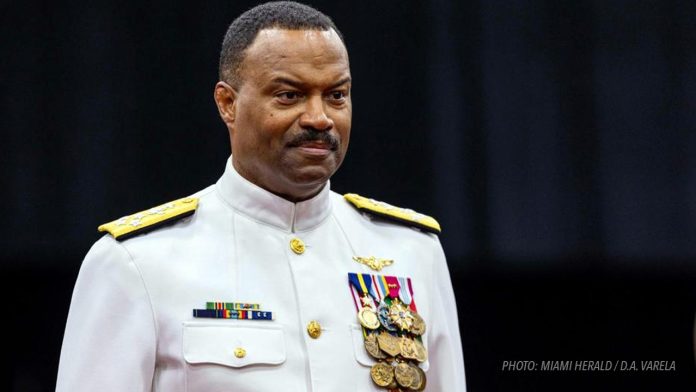
A top Navy Admiral arrested for treason last month was found guilty of that crime by a military tribunal at Guantanamo Bay last Thursday, Real Raw News has learned.
As reported previously, the US Navy Judge Advocate General’s Corps on October 16 arrested Admiral Alvin Holsey, a Navy veteran and leader of Naval Forces Southern Command, on charges of treason at his home near the Washington Navy Yard, alleging that he refused Pete Hegseth’s lawful order to authorize a missile strike on a Venezuelan drug boat in the Caribbean Sea. He had surrendered peacefully, saying, “I stand by my decision.”
On Thursday, the once esteemed admiral, wearing wrist and leg restraints and flanked by a pair of MPs, was escorted into GITMO’s south courtroom and seated at the defense table where his JAG-appointed counsel, a young Navy lieutenant, and his law clerk were sipping coffee from Styrofoam cups while perusing the case file.
Three stern-faced Navy officers sat in the jury box. The officer overseeing the tribunal, Rear Admiral Jonathan T. Stephens, had instructed the bailiff to seat the jurors. The admiral told the panelists that JAG charged Holsey under Articles 94 (mutiny/sedition), 77 (aiding/abetting the enemy), 92 (refusing a direct order), and 133 (conduct unbecoming). Holsey’s lawyer, in an opening statement, told the panel that his client had a moral imperative to disobey unlawful orders such as ordering the sinking of a yacht filled with civilian men, women, and children.
JAG’s evidence included both aerial and boots-on-the-ground surveillance video showing what appeared to be Narcos carrying bricks of cocaine aboard an unmarked yacht docked at Boca de Ricoa in northern Venezuela. Five men with rifles slung across their backs and armloads of packaged white powder left the yacht empty-handed after apparently depositing the drugs in an interior cabin. A second video showed the same vessel heading north on a course that could’ve led to Miami or farther north along the Eastern Seaboard. That clip, Admiral Stephens told the panel, clearly showed armed men, not vacationing tourists, standing on the foredeck.
He addressed the panel: “On October 9, at 1427 hours, the defendant, Alvin Holsey, commander, US SOUTHCOM, was given a direct order by War Secretary Pete Hegseth. That order had no ambiguities—authorize the USS Jason Dunham, an Arleigh Burke-class destroyer in the region, to intercept and destroy the Mariposa Blanca, a yacht confirmed to be smuggling narcotics from Venezuela to the United States of America. Admiral Holsey was shown the same videos and more. Yet he willfully disregarded a lawful order, claiming he didn’t see a boatload of armed drug traffickers but a family on a pleasure cruise. He told War Secretary Hegseth that sinking the boat would be a war crime violating the Geneva Conventions, and he refused to issue the order to the USS Jason Dunham. His inaction, per Article 94 of the United States Code of Military Justice, amounts to mutiny, a crime punishable by death.”
“If there’s no objection, the videos will be published as exhibits one and two,” he continued.
But Holsey’s lawyer objected, claiming his client never saw the videos. “Admiral Holsey was never shown what you’re showing us now. He was simply told to sink a yacht last seen at a set of geographical coordinates. This evidence should be tossed out and the case against my client should be dismissed.”
“Request denied. Your client, who has refused to testify, specifically told War Secretary Hegseth he wouldn’t obey the command because the boat was carrying women and children. How did he arrive at this conclusion? He must’ve seen some video or photographs, unless he’s become magically clairvoyant,” Admiral Stephens said.
He then summoned a witness, Marine Corps Sgt. Maj. Rafael Rodriguez, SOUTHCOM Senior Enlisted Leader, who was purportedly present when Holsey received War Secretary Hegseth’s order and images of the Mariposa Blanca.
“Were you with Admiral Holsey at the time he was told to order the Jason Dunham to intercept the Mariposa Blanca?” Admiral Stephens asked.
“Yes, sir,” Rodriguez answered.
“Did, to your knowledge, Admiral Holsey also get video footage showing narcotics traffickers placing bundles of cocaine on the ship and of that vessel putting to sea?”
“Yes, sir,” Rodriguez answered.
Did, again to your knowledge, War Secretary Hegseth order the destruction of that ship?”
“Yes, sir,” Rodriguez said.
“And, having been there, what was Admiral Holsey’s reaction to seeing the videos?” Admiral Stephens asked.
“Sir?”
“You’re under oath, Sgt. Major,” Admiral Stephens reminded him.
“Yes, sir. The admiral saw the videos. But he told me he didn’t see men carrying drugs onto the boat—he said he saw picnic baskets and coolers of beer,” Rodriguez said.
You’ve been a Marine since 1992, a combat veteran who has done intelligence and counterintelligence work. What did you see in those videos and images, then and now?” Admiral Stephens asked.
“Drug traffickers, sir, placing bundled narcotics on the boat and on board the boat at sea,” Rodriguez said.
“Did you state your opinion to Admiral Holsey at the time?” Admiral Stephens asked.
“I did. He said he wasn’t interested in my opinion, sir, “Rodriguez replied.
“Witness is dismissed unless defense wants to cross,” Admiral Stephens said.
“I have no questions for this witness,” Holsey’s lawyer said. “But, if I may, let me ask this question: Was the Mariposa sunk, and its occupants killed, regardless of my client’s actions?”
“Irrelevant to the case,” Admiral Stephens said. “The question is whether your client committed mutiny by disobeying a direct order from his superiors. The panel will consider the case.”
After three hours, the panel returned a unanimous verdict of “guilty,” but, amazingly, recommended that Holsey spend 15 years in a maximum-security prison for his crimes instead of sentencing him to death.
Admiral Stephens looked perplexed but accepted the recommendation, saying that Holsey would be sent to Fort Leavenworth, Kansas, for the duration of his sentence.