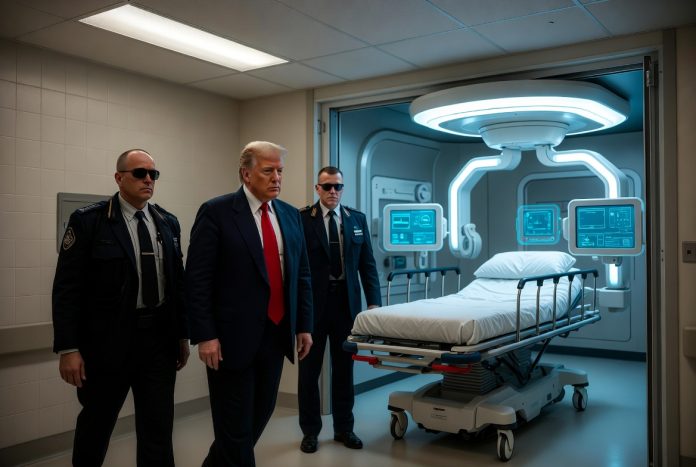
Med Beds, mythical rejuvenation chambers that purportedly heal malignancies and prolong life, are the reason President Donald J. Trump is still walking and talking and fighting foes, according to a Biomedical engineer whom the White House Office of Personnel Management contracted to repair a “prototype MRI” at Walter Reed.
Trump, now in his eighth decade of life, a time when most people die or fade into retirement, has allegedly extended his lifespan through the use of a revolutionary technology hidden behind guarded doors in the basement of Walter Reed. Shaped like an oversized, enclosed tanning bed, the device harnesses quantum healing fields, frequency modulation, and regenerative plasma to repair organs, reverse cellular degradation, and, theoretically, extend life. The device, as described, has long been dismissed as conspiracy fodder by mainstream science; nonetheless, stories about magical healing machines have for years appeared on alternative news sites and in fringe health journals. If this miraculous contraption exists, we haven’t seen it, nor could our source provide photographs, schematics, or a patent number to prove the apparatus is genuine. We decided to publish this piece as ‘food for thought’ after vetting his academic and employment credentials and based on our belief that, if Walter Reed had a Med Bed, his position there could have placed him in the covert room where it was housed. He asked for anonymity, so for simplicity, we’ll call him “Jake.”
Jake was not an official government employee; rather, he worked for Booze Allen Hamilton, an American management and technology consulting firm that provides advanced engineering, digital transformation, and cybersecurity services. The company operates primarily as a strategic partner and contractor for the federal government, including defense, intelligence, and civil agencies. On October 4, 2025, the source was offered a job to fix a Magnetic Resonance Imaging (MRI) scanner at Walter Reed. He told RRN his eyes bulged from their sockets when he saw the profitable contract. $6,500 for what he estimated to be a day’s work, providing he signed an aggressive non-disclosure agreement, a link to which appeared in his inbox the same day.
“It was the first time I’d been asked to sign an NDA to fix a piece of diagnostic equipment, and I’d fulfilled dozens of contracts for the federal government, most for the Veterans Administration. Nothing cloak-and-dagger about replacing magnets and cryogenic cooling, right?” the source said.
Before signing any documents, however, he replied to the email with questions he needed to know. Specifically, which manufacturer’s machine (GE, Siemens, or Philips) he would be fixing, and whether said manufacturer had already dispatched their OEM technicians to evaluate the problem. The response was ominously nebulous. He was told he’d learn more upon signing the documents.
“I was intrigued and needed the money,” Jake said, “so I agreed. But no more info, just a date to report to Walter Reed and a message telling me any tools and parts I’d need would be on site.”
When he showed up at Walter Reed on October 8, 2025, two men in dark suits and a woman from the US Office of Personnel Management (OPM) were there to greet him. The woman, the source reiterated, reminded him he had taken a vow of silence prior to escorting him to a blindingly bright room with a steel table, atop which sat an array of ‘inert’ superconducting magnets that, in an MRI, align the protons in a human body to allow radio signals to map soft tissue. The magnets, Jake told us, were misshapen, octagonal instead of square plates.
“Never saw anything like it before, and I’m familiar with every manufacturer’s equipment. I was told they got demagnetized. It can happen, but if and when it does, it happens over decades. Not on an MRI assembled in 2020—extraordinarily unusual. So, they’re staring at me, and I’m looking at the dead magnets, and I’m thinking to myself, ‘OK. Where are the new ones, the tools, and the MRI? It was a short, awkward silence, but it felt like forever. Finally, I ask, and the woman, well, it was [OPM Chief Privacy Office] Kirsten Moncada, she glares at me and wants my assurance I can do the job before I see the machine. I’m feeling a little spooked, but I’m not turning down payday. And again she repeated I’d signed an NDA and that everything there was confidential and proprietary—you get the picture,” Jake said.
He was led out of the room and down a narrow hallway ending at a door with a placard that read “Special Diagnostics.” Unlike other doors on the level, this one had biometric security, retinal and fingerprint scanners, and a security keypad. Only Moncada, Jake said, had credentials to unlock the door. As Jake stepped beyond the threshold, he felt certain Moncada had brought him to the wrong room, for the contraption he beheld was so dissimilar to any MRI he’d ever seen that he thought he was gazing at an overly engineered tanning bed. The eight-foot-long, capsule-shaped cradle had a hinged cover, its inside lined with what Jake first thought were fluorescent tubes.
“It was no MRI, open or closed,” Jake said. “There’s no gliding patient tray that draws you into the center of a scanner. This—you’d climb inside, lie flat on a cushioned bed, and the cover, or canopy, would close around you, sealing you inside. Kristen Moncada—she handed me six stapled pages—obviously copies taken from a technical manual—detailing how to replace the magnets in a side compartment. She asked me, almost hostilely, “Can you fix it or not?” And I say, out of curiosity, it would help if I had the entire manual and not just pages 64-69. She’s shaking her head from side to side, telling me no, that all I need to complete the job are the pages she gave me. And she’s right. Someone had already removed the ‘demagnetized’ magnets, and all I had to do was install new ones. I’m trying to hide my nervousness because I don’t know what the fuck I’m looking at, but I’m qualified to read schematics, and I know I can do what they want from me—in fact, a freshman engineering student could do it. I tell her, “Sure, no problem,” and extend my arm, palm up, and say, “cell phone.” It’ll be returned once you’ve finished the job.”
Jake surrendered his phone. Tools and magnetic plates arrived in a wheeled cart, pushed by a man clad from head to toe in medical coveralls. Jake said Moncada and the suits told him they’d remain in the room while he worked. When he unscrewed a panel behind which the magnets would lie, he saw a metal tag that resembled VIN tags on car door jambs, but this one had laser-etched phrases and numeric digits: “Bio Healing Bed” “2010929351B1.”
Based on Jake’s story, RRN thought the numbers might match those of a US patent or a pending patent, but USTPO, the US government’s website for patent searches, returned no results.
Jake completed the task in less than six hours, only to later learn that his fee had already been deposited into his bank account. As he prepared to leave, he couldn’t contain his curiosity and asked Moncada to explain the device.
“She grinned. ‘Ever heard of med beds?’ she said. ‘Well, this is it. Dissolves tumors, can reverse renal or liver failure, heal brain lesions, delay dementia and Alzheimer’s, cure various cancers, fix macular degeneration, you name it. I’m kidding, of course, it’s just a prototype imaging scanner.’ My career is grounded in science and engineering. I’ve never subscribed to woo pseudo-science. But I picked up on her body language; she was serious. Then she tells me I can’t leave yet—go home—until they’re sure the MRI works,” Jake said.
Moncada, he went on, booked for him a two-day stay at the Bethesda Tapestry Hotel. He had no freedom—suited escorts stood guard outside his door and tailed him whenever he left the room, even when he ventured to the lobby coffee lounge and the adjoining bistro.
At 7:00 a.m., October 10, 2025, Moncada roused Jake from bed, saying one of the magnets needed to be realigned immediately. She purportedly demanded two things: he fix the error and vacate the hospital by 10:30 that morning. When Jake got there, he realized, to his dismay, he had fucked up—he had misaligned two magnetic plates, a mistake he ascribed to exhaustion and people staring over his shoulder. It took him three hours to rectify the error, he told RRN, and Moncada demanded that he then return to his hotel room.
As Jake left the “Special Diagnostics” room and moved toward the elevator, its doors swung open. Four men in jet black suits surrounded a man who closely resembled Donald J. Trump, the 45th and 47th President of the United States of America. Jake watched the suits escort Trump to the “Special Diagnostics Room,” but, in his words, his spine tingled because the Trump he had seen was only approximately five-foot-ten-inches tall.
White House reports place Trump at Walter Reed for a CT scan on that date, but was it really Trump?
“I’m 6’4”. Trum’s supposed to be 6’3”. The guy I saw was a half-foot shorter than me, but, other than that, looked exactly like him, except for blotches all over his face, bruises on his hands, and what I’d call sunken eyes. I didn’t stick around. I got tied up in something I shouldn’t have, now I’m receding into the shadows,” Jake said.